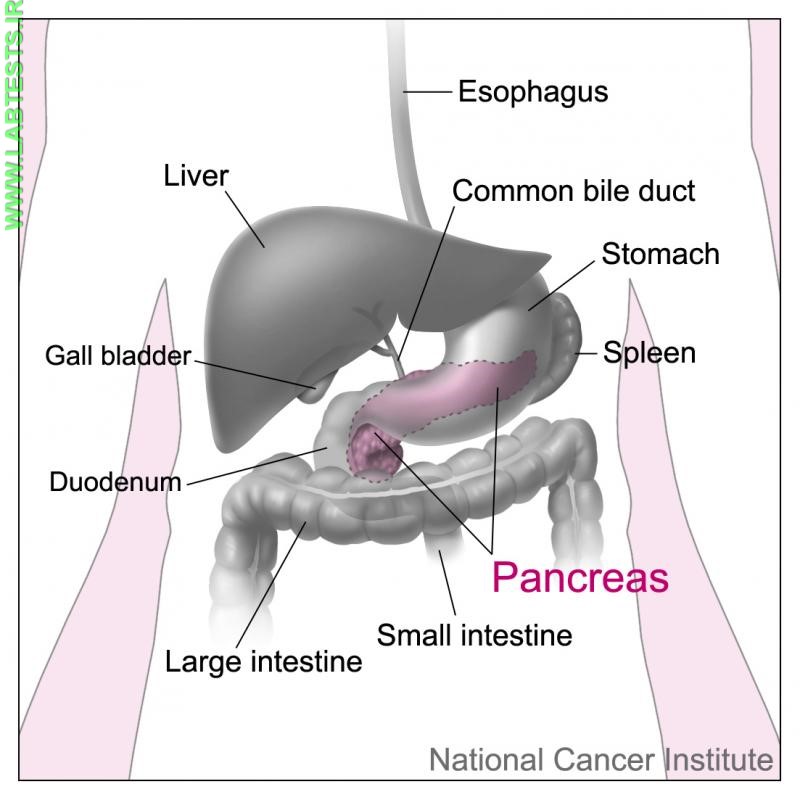
The pancreas is a narrow, flat organ about six inches long with head, middle, and tail sections. It is located deep within the abdominal cavity, below the liver and between the stomach and the spine. Its head section connects to the duodenum, the first part of the small intestine. Inside the pancreas, small ducts (tubes) feed digestive enzymes produced by the pancreas into the pancreatic duct. This large duct carries the digestive enzymes down the length of the pancreas, from the tail to the head section, and into the duodenum. The common bile duct also runs through the head section of the pancreas, carrying bile from the liver and gallbladder into the small intestine. The bile duct and pancreatic duct usually join just before entering the duodenum and share a common opening into the small intestine.
The pancreas consists of two kinds of tissues:
- Exocrine -- tissues that make powerful enzymes to digest fats, proteins, and carbohydrates. The enzymes normally are produced and carried in an inactive form to the duodenum, where activation then occurs as needed. Exocrine tissues also make and secrete bicarbonates that neutralize stomach acids and allow for the activation of pancreatic enzymes.
- Endocrine -- tissues that produce the hormones insulin and glucagon and release them into the bloodstream. These hormones regulate glucose transport into the body's cells and are crucial for maintaining normal glucose levels and energy production.
Common Diseases of the Pancreas
Pancreatitis
Pancreatitis is an inflammation of the pancreas. It is often associated with early activation of digestive enzymes in the cells and ducts of the exocrine pancreas, instead of in the duodenum, that start "digesting" (destroying the tissues of) the pancreas itself. It usually presents with abdominal pain and can cause nausea and vomiting.
- Acute pancreatitis may be a single or a recurring event, and it usually occurs suddenly. The abdominal pain with acute pancreatitis is often severe. Secretions can back up in the pancreas and cause permanent damage in just a few hours. Acute pancreatitis often presents with raised levels of pancreatic enzymes in the blood. These enzymes can circulate to other body organs, causing shock and organ failure. Acute pancreatitis can lead to internal bleeding and infection and can be life-threatening. The most common cause of acute pancreatitis is blockage of the pancreatic duct (obstruction), usually due to gallstones and sometimes due to particles (sometimes tiny gallstones) in bile that have precipitated (biliary sludge). Because these pass through the bile duct, they may cause blockage of the common duct through which both biliary and pancreatic secretions pass into the duodenum. Other causes may include alcohol excess, smoking, physical trauma to the abdomen, exceedingly high blood triglyceride level, and high blood calcium level.
- Chronic pancreatitis is characterized by chronic or persistent abdominal pain and may or may not present with raised pancreatic enzymes. It develops gradually, often results in slow destruction of the pancreas, and can lead to other problems, such as pancreatic insufficiency (see below), bacterial infections, and type 2 diabetes. The main causes of chronic pancreatitis are gallbladder disease (ductal obstruction) and genetic risks, which are increased by modifying factors such as alcoholism. Other causes include high blood calcium level and very, very high triglyceride level, some drugs, and autoimmune conditions. Hereditary chronic pancreatitis results from mutations that affect the secretion of digestive enzymes, such as cystic fibrosis, or mutations that result from cellular changes brought on by inflammatory signals associated with repeated acute or chronic pancreatitis.
Pancreatic Cancer
Cancer of the pancreas is the fourth leading cause of cancer death in the United States, killing more than 39,000 people a year. Risks include smoking, age, sex (more common in men), chronic pancreatitis, and exposure to some industrial chemicals.
About 95% of pancreatic cancers develop in the exocrine tissues. Pancreatic cancer is very difficult to detect in the early stages because symptoms are either absent or nonspecific: abdominal pain, pruritus, nausea, loss of appetite, and sometimes jaundice. Tumors near the head section that block flow to the intestine may be detected earlier. Only about 10% of the cancers are still contained within the pancreas at the time of diagnosis, which makes effective treatment very difficult. Additionally, pancreatic cancer does not respond well to current treatments. A variety of clinical studies and research efforts are being conducted on an ongoing basis to discover more effective methods.
Pancreatic Insufficiency
Pancreatic insufficiency is not a primary disorder but is secondary to the other causes of pancreatic disease. It is the inability of the pancreas to produce and/or transport enough digestive enzymes to break down food in the intestine. It typically occurs as a result of progressive pancreatic damage, damage that may be caused by a variety of conditions. It is most frequently associated with cystic fibrosis in children and with chronic pancreatitis in adults; it is less frequently but sometimes associated with pancreatic cancer and other diseases that are considered to be "non-pancreatic causes" of insufficiency.
To find out more about some of the less common pancreatic diseases, visit the Rare Syndromes page at Pancreas.org.