

To assess the risk of developing breast or ovarian cancer associated with hereditary mutations in the BRCA1 or BRCA2 genes
BRCA Gene Mutation Testing
BRCA Gene Mutation Testing
Also Known As
BRCA
Breast Cancer Susceptibility Genes 1 and 2
Formal Name
Breast Cancer Gene 1; Breast Cancer Gene 2
This article was last reviewed
on
This article waslast modified
on June 18, 2018.
At a Glance
Why Get Tested?
When To Get Tested?
When your personal or family history suggests the presence of a harmful BRCA mutation, such as you or someone in your family has had breast cancer before the age of 50 or ovarian cancer at any age, is a male with breast cancer, or when a BRCA1 or BRCA2 mutation has been identified in a family member
Sample Required?
A blood sample drawn from a vein in your arm or an oral rinse that collects cells from your mouth
Test Preparation Needed?
None, but genetic counseling is strongly recommended to confirm that you meet the testing criteria. If the sample is a saliva-based specimen, it is recommended that you not eat, drink, or chew gum for at least an hour prior to your testing appointment. Furthermore, kissing should also be avoided immediately prior to testing.
Accordion Title
Common Questions
-
How is it used?
Standard BRCA1 and BRCA2 tests are used to detect mutations that are known to increase the risk of breast and ovarian cancer development. If a BRCA1 or BRCA2 mutation has been identified in a family member with breast and/or ovarian cancer, then that specific mutation can be tested in other family members to assess their risk. Specific BRCA1 and BRCA2 mutations are associated with some ethnic groups, such as those of Ashkenazi Jewish descent, and can be used to evaluate the risk of individuals in this group.
Only about 0.2% of the U.S. population carries a BRCA1 or BRCA2 mutation. Because of this, genetic testing is not recommended for the general population.
BRCA1 and BRCA2 mutation testing should be considered for individuals with a personal or family history that suggests the presence of a harmful BRCA1/BRCA2 mutation. There are a variety of screening tools to help assess the risk of having a BRCA mutation. Some of the risk factors include:
- Cancer in both breasts
- Breast cancer diagnosed at a young age, before age 50 years
- Both breast and ovarian cancers in the same individual, or both breast and ovarian cancers in separate family members
- Multiple breast cancers in the family
- A single family member with two or more primary types of BRCA1- or BRCA2-related cancers
- Breast cancer in a man or male relative
- Breast cancer that is "triple negative" (estrogen receptor (ER), progesterone receptor (PR), and HER2 negative)
- Ashkenazi Jewish ancestry
These factors should be considered for both the mother's and father's sides of the family.
It is recommended that people be counseled by a genetics educator both before and after BRCA mutation testing to receive genetics education to fully understand the implications of a positive and/or negative result.
-
When is it ordered?
BRCA1 and BRCA2 mutation testing is not recommended as a screening tool for the general population. When someone has a personal or family history that suggests the presence of a harmful BRCA mutation, that person may choose to undergo testing. (Risk factors are listed above.) Someone who is considering testing should talk to their healthcare practitioner and seek counseling by a genetics educator/counselor prior to and after testing.
-
What does the test result mean?
The presence of a BRCA1 or BRCA2 mutation means that the person tested is at an increased risk for developing hereditary breast and/or ovarian cancer syndrome. It also indicates that the individual's family members may be at increased risk for breast or ovarian cancer. However, even within a family with the same BRCA mutation, not everyone will develop cancer and those who do may develop it at different times during their lives. According to the National Cancer Institute, estimates of lifetime risk for breast cancer in women are 55% to 65% for BRCA1 mutation and 45% for BRCA2 mutation. Risk of ovarian cancer is 39% with BRCA1 mutation and 11% to 19% with BRCA2 mutation.
-
Is there anything else I should know?
The degree of risk conferred with a positive result is difficult to quantify for a specific person. Results must be interpreted in conjunction with the tested person's personal and family history. A genetic counselor should explain the meaning of the results, treatment options for the individual that are intended to decrease risk, and testing options for other family members.
Genetic testing for BRCA1 and BRCA2 mutations cannot detect 100% of these mutations; thus, even with a negative result there is very small chance that there is a BRCA1/BRCA2 gene mutation present that was not identified by the testing method utilized. In addition, there are other genes that may have mutations that can contribute to a family's risk for cancer. Genetic testing for just BRCA1 or BRCA2 will only detect mutations in these two genes; therefore, if a mutation is present in another gene known to cause an increased risk for breast cancer, BRAC1/BRCA2 mutation testing will not detect it.
In addition, sometimes a personal or family history of cancer may suggest a factor or combination of other factors that contribute to a person's risk. In these families, it is likely that common risk factors such as shared genes that only sometimes cause cancer (low penetrance), shared environment and exposures, and shared lifestyle habits are increasing the risk for cancer above that of the general population. While individuals in these families typically do not have increased risks anywhere near as high as those seen in individuals with BRCA1 or BRCA2 mutations, they often will have increased risks for cancer slightly above those of the general population and sometimes increased cancer surveillance is recommended.
Positive test results may have implications for other family members. When one member of a family is tested for BRCA mutations, issues often arise about how to share this information with other family members. It may be helpful to seek advice from a genetic counselor about how to communicate results with other family members.
Pre- and post-test consultation with a genetic counselor about genetic testing cannot be overemphasized. There are many issues to be considered when preparing for a genetic test and upon learning the results, and a genetic counselor has the knowledge and expertise to help sort through them.
-
If the BRCA mutation test is positive, what are my options?
If the BRCA mutation test is positive, the options include more frequent cancer screenings and screening starting earlier in life (e.g., mammography, breast MRI, blood tests for CA-125 or CA 15-3, or transvaginal ultrasonography), medications that could reduce risk (e.g., tamoxifen), or surgical removal of the ovaries or breasts. There are a number of variables involved and it is important to discuss your options with your healthcare provider and genetic counselor.
-
Where can I get this test?
The test can be ordered by a healthcare practitioner or genetic counselor. The sample will be sent to a laboratory that specializes in BRCA mutation testing. The American Society of Clinical Oncology and the National Breast Cancer Coalition encourage women seeking the test to participate in long-term outcome studies to help gather information on the effectiveness of different check-up and treatment options. See the Related Content section of this article for links to additional information.
-
Are people with BRCA mutations at risk for other cancers?
The BRCA mutations' role in cancer risk is an active area of research. In addition to breast and ovarian cancer, the mutation has been linked to prostate and pancreatic cancer. As of 2015, studies have found that the BRCA mutation is present in 0.5%-4% of prostate cancers and 5%-8% of pancreatic cancers.
However, researchers are still gathering information about how BRCA mutation testing should be incorporated into screening for those cancers. For example, while researchers are finding that men carrying BRCA mutations have an increased risk for prostate cancer, it is still unclear what family or personal history factors should prompt men in the general population to receive BRCA mutation testing. The National Comprehensive Cancer Network does recommend that men carrying BRCA2 mutation begin prostate cancer screening at 40 years old. For pancreatic cancer, there are no data showing that BRCA mutation screening improves cancer survival. There are currently no guidelines for BRCA mutation testing and pancreatic cancer.
Related Images and Videos

View More
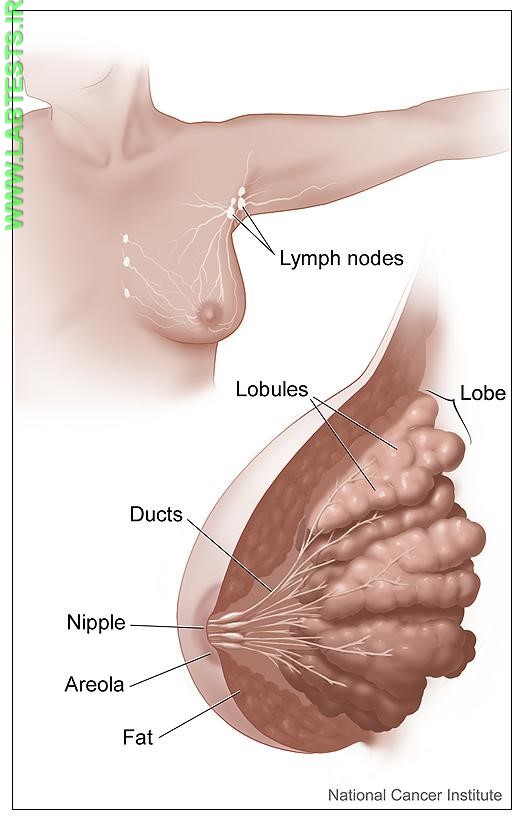
Breast anatomy. Image credit: Don Bliss, National Cancer Institute

View More
Video credit: Centers for Disease Control and Prevention

View More
Breast Cancer and the Genetic Connection: Why Personalized Care Is Key. Video Credit: Patient Power


